
Slowing water — by design
BY SUSAN HIRSHORN
Runoff is a serious urban problem; plants and construction techniques are offering solutions
Ampersand is a new residential complex in a suburban area of Ottawa that is designed with an urban feel. Geared to residents looking for affordability and convenience, its townhomes and condos are integrated with commercial and retail space as well as a large park, all within walking distance of buses and proposed light rail transit. Ampersand is also about sustainability. The homes are built to LEED (Leadership in Energy and Environmental Design) standards. To reduce stormwater runoff, the site also incorporates a number of water-sensitive urban design strategies known as Low Impact Development, or LID.
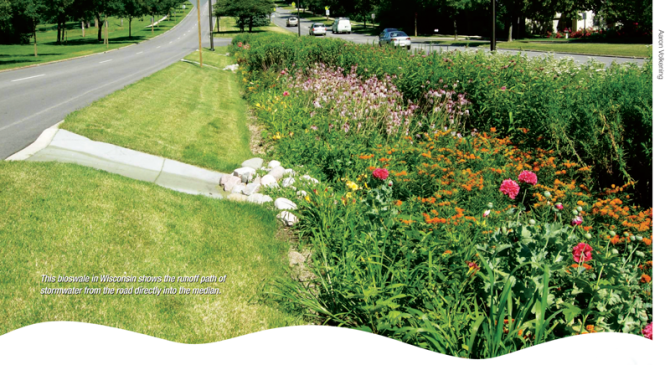
LID is an approach to land development (or re-development) that aims to capture, slow or infiltrate stormwater close to where it falls. Using vegetation, permeable paving materials and other techniques that mimic natural hydrologic systems, LID reduces the volume of overland runoff that contributes to flooding. It also prevents pollutants from flowing into waterways and oceans.
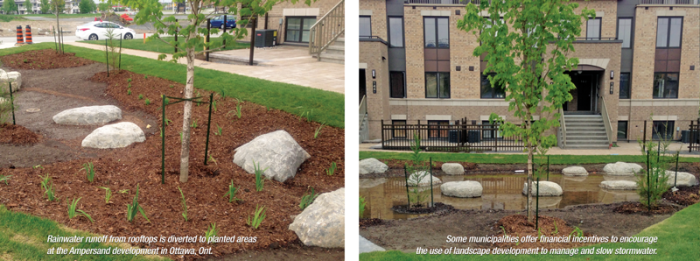
Among the LID features at Ampersand are extensive tree coverage and diverse, drought-tolerant plantings with no need for irrigation after establishment. The runoff from several rooftops is directed into planted areas, without affecting foundations or retaining walls, according to Derek Hickson, an engineer for Ampersand’s developer, the Minto Group.
Two rain gardens receive overland flow from the park. Elevated drains direct overflow during large storms into a perforated pipe which is both surrounded by clear stone and connected to storm sewers. Most of the water infiltrates into the ground, recharging the groundwater.
The complex also features pedestrian-friendly routes free of garages and driveways. “We minimized paved surfaces by locating most parking underneath the buildings,” says Hickson. “In urban development, the greatest source of stormwater runoff comes from impervious surfaces, such as roads and roofs.”
Canada wakes up
LID has been around for nearly two decades and its use is well established in the United States and Great Britain. Although Canada has been slower to embrace it, serious flooding in many areas of the country has awakened interest in LID.
According to the Insurance Bureau of Canada, “Water damage is now the leading cause of property damage in Canada, costing insurers approximately $1.7 billion per year.” The Institute for Catastrophic Loss Reduction (ICLR) is an independent research arm of Canada’s property and casualty insurance industry. It has expressed support of LID as a way to help provide a long-term solution to urban flood losses.
Municipalities around the country have adopted — or are considering — new bylaws involving LID. Stipulations include disconnecting downspouts to reduce the load on wastewater systems; limiting or taxing hard, impervious surfaces and requiring green roofs for buildings over a certain size. The cities of Toronto, Port Coquitlam, B.C., and Richmond, B.C., for example, have green roof bylaws.
“Most municipalities are getting comfortable with LID — and it’s a learning process for everyone, including the developers and contractors,” says Chris Denich of Aquafor Beech, a Mississauga, Ont.- based firm that provides water resources engineering and environmental services including LID planning for public and private sector clients in several provinces. “Although not every LID strategy or installation is suitable for every condition, the system is flexible and dynamic,” he adds. “You’re given a basket of tools. It’s up to the designer and developer to select the ones that are most appropriate
for the site.”
Cost and maintenance still key concerns
At Ampersand, Minto examined the feasibility of green roofs, but decided against them because of the cost of structural reinforcement needed for support on four-storey, wood-frame buildings. Similarly, it was more cost effective and aesthetically appealing to minimize paved surfaces and increase space for planted areas, than to pave surfaces with such LID-friendly materials as permeable pavers or porous asphalt. Vegetated surfaces also eliminated the city’s maintenance concerns about snow removal with permeable pavers. The city did agree to let Minto install a small permeable paver test area in the Ampersand park. The test area will not be maintained during winter months, thus eliminating possible damage from de-icing salts and snowplows.
Rain gardens a popular choice
Vegetated installations, especially rain gardens, have become a popular LID installation for municipalities and property owners looking for lower initial cost and maintenance. “When properly constructed, rain gardens can absorb 30 to 40 per cent more rain than a standard lawn,” says Amanda Marlin, Executive Director at EOS Eco-Energy, a Sackville, N.B., not-for-profit organization promoting sustainable community planning.
After Marlin proposed various LID strategies to the town of Sackville, a rain garden pilot project was accepted. The project involved three rain gardens strategically placed around town. Marlin has already been told by property owners living downhill from the gardens that their lawns are “no longer soaked and squishy,” after heavy rains. Plans are underway to expand the rain garden project to surrounding municipalities, Marlin says.
Financial incentives driving the market
Although LID-based strategies and practices may soon become a municipal requirement, right now various types of financial incentives are driving the market. The Sackville rain garden pilot project received funding from the New Brunswick Environmental Trust Fund. Minto’s low-impact research and technical activities at Ampersand were aided by a grant from the EQuilibrium Communities Initiative, which was jointly funded by Canada Mortgage and Housing Corporation and Natural Resources Canada.
Will property and casualty insurers who stand to benefit from LID be reducing premiums for property owners with LID installations? Dan Sandink of research institute ICLR says, “I have not seen insurers incentivize [measures such as rain gardens, infiltration features, etc.]. It may be difficult to provide evidence that these measures provide a direct risk reduction benefit to individual property owners, though there are clear benefits when these measures are adopted at a watershed/regional scale … I have seen a couple of examples of insurers considering downspout connections in property underwriting questionnaires. This may or may not lead to an incentive, depending on the risk of the insured. They should check with their broker or agent to see what their insurer might consider.”
At the government level, municipalities with stormwater utilities are key drivers of the LID market, often promoting stormwater management with a carrot-and-stick approach. It requires property owners with more impervious surfaces on their lots to pay higher utility bills, while giving credits to those who make LID improvements. In Kitchener, Ont., property owners are now able to apply for stormwater credits of up to 45 per cent on the stormwater portion of their utility bills, for such measures as rain barrels, cisterns, infiltration galleries, rain gardens and permeable pavers. Victoria, B.C., will be introducing a similar system in 2015.
Green industry opportunity
Clearly, this trend offers many opportunities for the landscape trades. Since plants are a significant component of LIDs, they can drive business to local nurseries. The need for special expertise in installing or maintaining permeable pavers, green roofs, rain gardens, bioswales and other features has the potential to carve out lucrative markets for contractors, agrees Denich, who has supervised LID installations at many sites across Ontario. “Unfortunately, we just had a project where we were looking for experienced contractors and we had a very low turnout in terms of finding contractors with the necessary LID expertise,” he says. “Contractors, developers and other concerned individuals need to educate themselves about LID best practices, what new materials are available and where to get those materials. Our climate is changing. The nature of municipal infrastructure is changing. Public opinion on what constitutes infrastructure is changing and we all need to change with it.”
Learn more about LID
The Toronto and Region Conservation Authority (TRCA) and Aquafor Beech have developed 
a fee-based online training course which covers the basics of LID.
www.thelivingcitycampus.com
The Interlocking Concrete Pavement Institute offers a program which certifies installers of permeable concrete interlocking pavers.
www.icpi.org
Many other organizations offer LID learning programs, workshops, case studies, conferences and more. These include:
Susan Hirshorn is a Montreal-based writer, editor and communications consultant.