
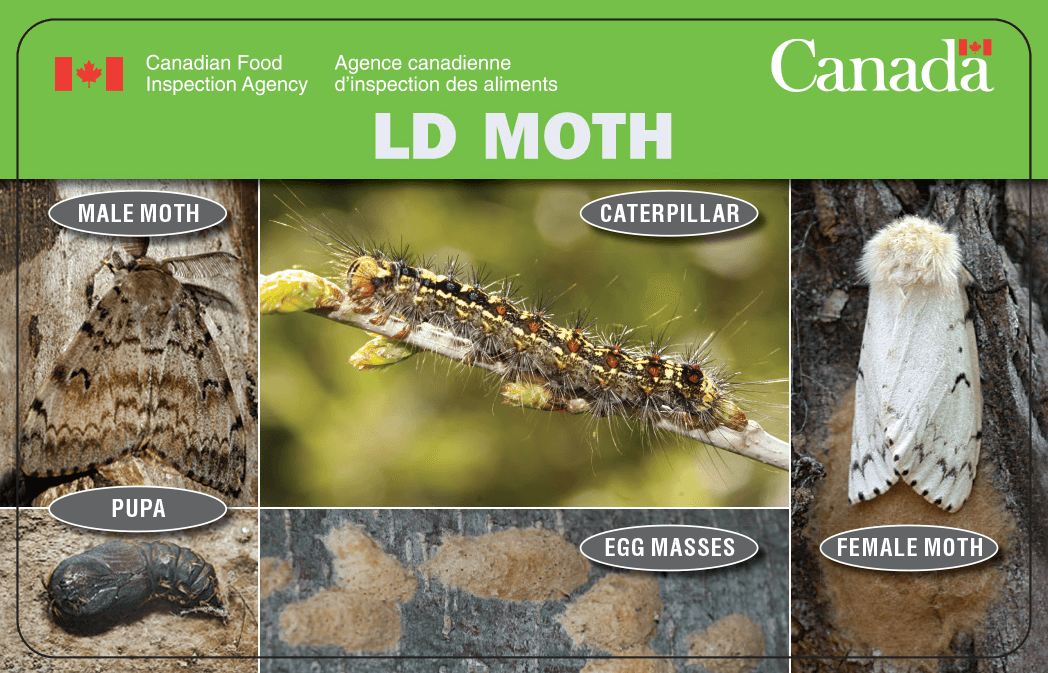
Not to be confused with LD Moth (which is extremely prevalent in Ontario this year), Box Tree Moth is a new pest in Ontario that is primarily found on boxwood plants (not in trees).
Box Tree Moth |
LD Moth |
Box Tree MothFound only on boxwood plants (shrubs) |
LD MothFound in large trees |
Box Tree MothOnly sightings outside the regulated zone need to be reported. |
LD MothOnly sightings outside the regulated zone need to be reported. |
Box Tree MothA relatively new pest |
LD MothA well-know and established pest |
Box Tree MothFound in Ontario from east of Toronto to Windsor. |
LD MothFound throughout Ontario. The City of Toronto has established management practices in place. |
Box Tree MothLearn more about this invasive pest. |
LD MothLearn more about this invasive pest. |
Home and property owners should take a minute to learn the differences between these two pests. For proper removal of infected plants and clippings, read here.
The Canadian Food Inspection Agency (CFIA) provides Pest Identification Cards that show what each moth looks like.

Box Tree Moth is primarily found on shrubs, not trees. Boxwood have green leaves and are typically used as hedges.
 Boxwood sold from a nursery or garden centre in a container.
 Close-up of boxwood foliage (leaves).
 Boxwood is typically used as a hedge and can grow up to 5 feet tall.
Examine all boxwood plants for signs of chewed leaves, larvae, webbing and frass. Larvae feed from May to September.
 Cocoon.
 Feeding damage. Leaves turn brown.
 Note the webbing among chewed leaves.
 Young larva.
 Adult moth.
 Adult moth.
If you have the pest there is a biological control spray called Dipel that is registered for control of Box Tree Moth. The active ingredient of the spray is safe to humans and pets and is the same as the one in BTK caterpillar killer sold at most retail garden centres. The same active ingredient is used by the City of Toronto to control Gypsy Moth. To kill the larvae, sprays need to be applied when larvae are feeding on leaves, typically from mid-May to mid-June and from mid-July to mid-August and early September.
If you wish to hire a professional, we suggest you contact one of these licensed contractors to spray your boxwood:
High populations of box tree moth caterpillar may defoliate boxwood plants; in some severe cases this can result in plant dieback. It may be necessary to remove or trim the infested shrub. Effective removal and disposal of infested plants is crucial to slowing the spread of box tree moth. Please follow the measures below to help prevent the spread of this pest to locations where it is not present:
Moving forward, it is recommended that boxwood plants receive continual management to ensure box tree moth is controlled and to prevent further plant damage. Plants should be inspected during the general predicted larval periods for each generation of box tree moth, during the following dates:
If caterpillars are found actively feeding on the plants, an application of BTK (Bacillus thuringiensis kurstaki) should be applied. Re-inspect the plants 5-7 days after application to ensure it was effective. If live, actively feeding caterpillars are still found, another application should be applied. Routinely monitor the condition of your boxwood plants and presence of caterpillar larvae and feeding damage. BTK application is most effective when used two or three times a year during the time frames listed above.
www.inspection.gc.ca and LandscapeOntario.com/tag/box tree moth


